Stadiums of
World Cup 2026
 USA
USA








 Canada


 Mexico


Navigating the 2026 World Cup Host Cities
Sixteen cities. Three countries. One tournament. The 2026 FIFA World Cup is unlike anything the sport has attempted before, and getting from one match to the next requires more planning than most fans realize.
Three Nations, One Tournament
Canada, Mexico, and the United States are sharing hosting duties, with two Canadian cities, three Mexican, and eleven spread across the US. That's a lot of ground to cover. The 2026 FIFA World Cup host cities and stadiums stretch from Vancouver on the Pacific coast all the way to Miami, meaning a fan chasing their team through the group stage could theoretically log more air miles than a flight attendant.
For the full match schedule, the official FIFA World Cup 2026 format and schedule page is worth bookmarking now.
Canada's Two Host Cities
Toronto and Vancouver are both well-equipped for an influx of international visitors, each with solid transit infrastructure and major international airports. Check the Canadian host cities map to get a feel for how they sit geographically.
Toronto
Pearson International (YYZ) handles the bulk of international arrivals. Once you're in the city, the Toronto Transit Commission runs subway, streetcar, and bus lines that connect reasonably well to BMO Field. If you're thinking about combining Toronto with a US match, flights to Boston or New York are short, and VIA Rail covers longer domestic routes. Cross-border bus services exist too, though they're slower.
Vancouver
Vancouver International (YVR) is one of Canada's busiest airports, and TransLink's SkyTrain gets you downtown without the cab fare. BC Place is easy to reach from the city center. Seattle is roughly three hours south by bus or train, which makes Vancouver a natural pairing for fans who want to catch games on both sides of the border.
Getting Around Mexico's Three Venues
Mexico's host cities are spread far enough apart that domestic flights are usually the practical choice. Bus travel between them is possible, but the distances are significant.
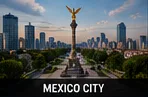
Mexico City
Benito Juárez International (MEX) is one of Latin America's busiest airports. The city's Metro system is genuinely efficient for getting around, and Estadio Azteca is accessible by public transit. Ride-sharing works well for shorter hops. Mexico City is the only capital among all 16 host cities, and it's hosting the opening match, so expect demand for accommodation to spike early.
Guadalajara
Guadalajara International (GDL) connects the city to the rest of Mexico and beyond. The local SITEUR light rail covers some ground, but taxis and ride-shares fill in the gaps for reaching Estadio Akron. Flying is the most sensible option if you're combining Guadalajara with Mexico City or Monterrey.
Monterrey
Monterrey sits in northern Mexico, which puts it within reasonable reach of Texas. Monterrey International (MTY) has direct flights to Houston and Dallas, making it a logical starting or finishing point for fans planning a cross-border itinerary. The city's Metrorrey system has three lines, and Estadio BBVA is accessible without much hassle.
The US Cities, Broken Into Regions
Eleven cities across one country still covers enormous distances. Grouping them by region makes the travel math much easier.
East Coast
New York/New Jersey, Boston, Philadelphia, Miami, and Atlanta form a loose eastern cluster. The three northeastern cities are the most connected by ground, with Amtrak's Northeast Corridor running between New York, Philadelphia, and Boston. MetLife Stadium, Gillette Stadium, and Lincoln Financial Field are all reachable without flying. Miami and Atlanta sit further south and are better served by air, though both cities (MIA and ATL) are major hubs with connections everywhere.
Central Region
Kansas City, Dallas, and Houston are spread across the middle of the country. Flying is the default here. Dallas has two airports (DFW and DAL), Houston has two as well (IAH and HOU), and Kansas City's MCI has improved considerably in recent years. Ride-sharing is the most reliable way to reach GEHA Field at Arrowhead Stadium, AT&T Stadium, and NRG Stadium once you land.
West Coast
Los Angeles, the San Francisco Bay Area, and Seattle anchor the western end of the tournament. LAX, SFO, and SEA all handle heavy international traffic. California's high-speed rail is still under construction and almost certainly won't be ready by 2026, so flights between LA and San Francisco remain the practical option. Each city has its own transit network: Metro in LA, BART and Muni in San Francisco, and Link Light Rail in Seattle, all connecting airports to the city and to venues like SoFi Stadium, Levi's Stadium, and Lumen Field.
| Region | Host Cities | Key Stadiums |
|---|---|---|
| Canada | Toronto, Vancouver | BMO Field, BC Place |
| Mexico | Mexico City, Guadalajara, Monterrey | Estadio Azteca, Estadio Akron, Estadio BBVA |
| USA East Coast | New York/New Jersey, Boston, Philadelphia, Miami, Atlanta | MetLife Stadium, Gillette Stadium, Lincoln Financial Field, Hard Rock Stadium, Mercedes-Benz Stadium |
| USA Central | Kansas City, Dallas, Houston | GEHA Field at Arrowhead Stadium, AT&T Stadium, NRG Stadium |
| USA West Coast | Los Angeles, San Francisco Bay Area, Seattle | SoFi Stadium, Levi's Stadium, Lumen Field |
Plan Early, Plan Specifically
The sheer scale of this tournament catches people off guard. Flights between host cities will fill up fast, particularly around the knockout stages. Book accommodation near transit lines rather than near stadiums, where prices will be inflated. And if you're crossing borders, check visa requirements well in advance since Canada, Mexico, and the US each have their own entry rules that don't automatically apply to one another.
Frequently Asked Questions About the 2026 Host Cities
How many cities will host games for the 2026 World Cup?
The tournament will be hosted across 16 cities in total: two in Canada, three in Mexico, and eleven in the United States.
Which countries are hosting the 2026 FIFA World Cup?
The 2026 FIFA World Cup will be co-hosted by three North American nations: Canada, Mexico, and the United States.
How can I travel between different host cities?
Due to the vast distances, domestic flights will be the primary mode of transport between most of the host cities. For shorter distances, particularly in the Northeast US corridor, rail and bus services may be viable.
Will specific venues for the 2026 FIFA World Cup be announced soon?
The stadiums for all 16 host cities have already been selected and announced as part of the initial host cities list release.
Are there any specific travel advisories for navigating the host countries?
While general travel advisories are always recommended, each host nation (Canada, Mexico, USA) has its own entry requirements and local customs. Visitors should research country-specific visa information and local transport guidelines well in advance.